A day around the hall
Samarkand sights to pair with the show
Four Samarkand monuments that fit a day around the Marokand Concert Hall show: Registan, Gur-e-Amir, Bibi-Khanym and Shah-i-Zinda, in a sensible order.
Reserve a seat in Samarkand ↗Quick answer
Pair the concert hall show with the monuments Wikipedia names as the city's iconic symbols: Registan Square with its three madrasas, the Gur-e-Amir mausoleum of Timur, the Bibi-Khanym Mosque and the Shah-i-Zinda necropolis. Put the monuments earlier in the day, book the show for a date and time that suits you, and take a taxi between the stops.
Start at the Registan
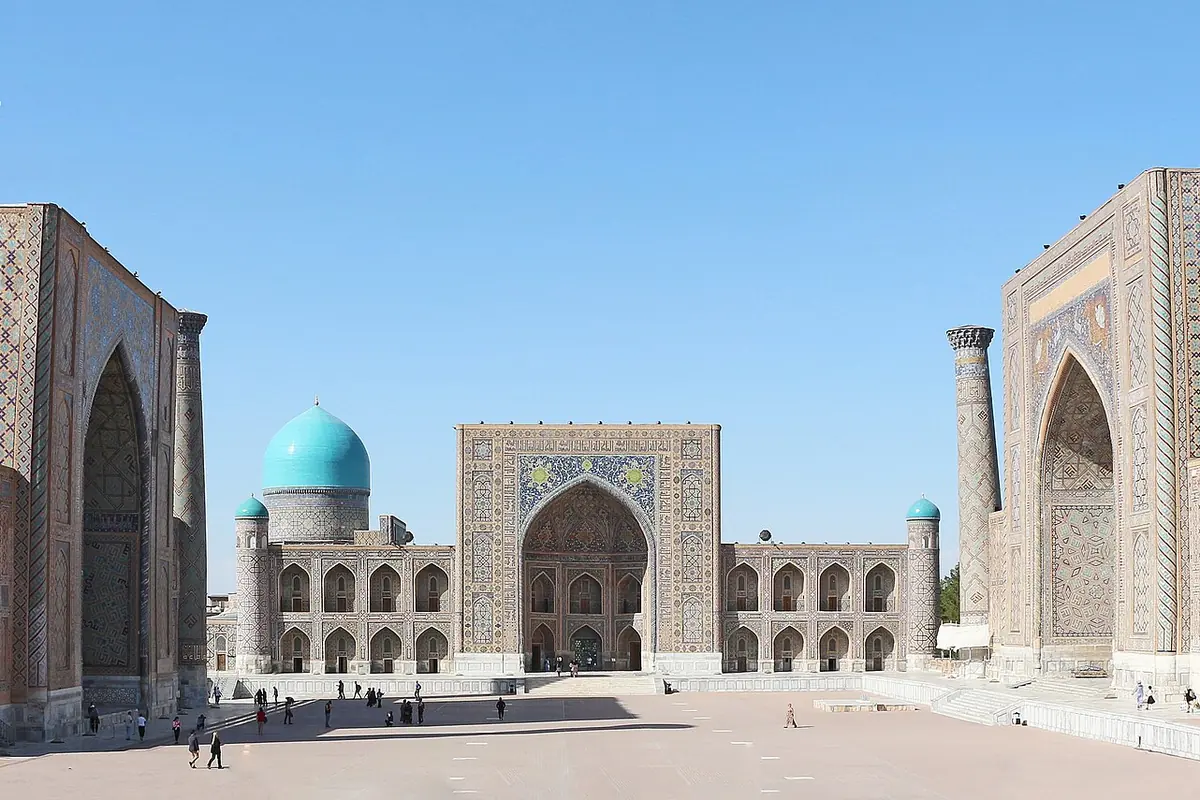
Registan Square is the city's historic public square and the heart of the Timurid Empire, according to Wikipedia. Its ensemble of three madrasas, Islamic schools, is among the finest achievements of Islamic architecture in Central Asia, with soaring iwans, turquoise domes and mosaic tilework. Wikipedia adds that people gathered there to hear royal proclamations. Because the ticket describes the hall as a short drive from Registan Square, the square is the natural fixed point for your day.
Three madrasas, three centuries
The Ulugh Beg Madrasa dates from 1417 to 1420 and was built under Timur's grandson, who lectured there himself. The Sherdar Madrasa followed between 1619 and 1636; its name means the lion-bearing madrasa, and its portal carries mosaic tigers with a rising sun on their backs. The Tilakari Madrasa, built between 1646 and 1660, is the gilded one, and the main hall of its mosque is abundantly gilded. Read the three together and you see how the square grew across more than two centuries.
Gur-e-Amir
The Gur-e-Amir is the mausoleum of Timur, also known as Tamerlane. Its azure fluted dome crowns an octahedral building, and its walls are tiled in blue, light-blue and white against terracotta brick. Construction began in 1403 after the death of Timur's grandson Muhammad Sultan, for whom it was intended. Timur died in 1405 and was buried here, and Ulugh Beg completed the work. Inside are the tombs of Timur, his sons Shah Rukh and Miran Shah, and grandsons Ulugh Beg and Muhammad Sultan. Wikipedia notes that the mausoleum has been heavily restored.
Bibi-Khanym and the bazaar
The Bibi-Khanym Mosque was erected by order of Timur in 1399 to 1405 and is named for his wife, Saray Mulk Khanum. Wikipedia calls it one of the most important monuments of Samarkand. Wikipedia's Registan article adds that the bazaar once located at Chorsu, behind the Sherdar Madrasa, is now the Siyob Bazaar, near the mosque. That makes the mosque and the market a natural pair.
Shah-i-Zinda
Shah-i-Zinda is a necropolis in the north-eastern part of Samarkand, and its name translates from Classical Persian as the Living King. Wikipedia says the complex was formed over eight centuries, from the 11th to the 19th, and now includes more than twenty buildings. Wikipedia's Samarkand article adds that the memorial complex was founded by the rulers of the Karakhanid dynasty in the 11th century. As at any mausoleum, dress modestly and keep your voice low.
An order for the day
Take the monuments in the order that keeps taxi rides short, and let the show decide the end of the day. Group the stops by area on a map, and treat Gur-e-Amir, Shah-i-Zinda and the Bibi-Khanym Mosque as separate stops from the Registan. The show needs its own trip, so check the booking calendar's start time before you plan the last sight. Leave a gap after the final monument for a rest and a meal, as the show has no meal and runs for about an hour.
Who this isn't for
This is a pairing guide, and not a full itinerary. It does not give opening hours, entry rules or fees, which change, so check them locally before you go. If your time in Samarkand is under a day, choose the Registan and the show and leave the rest. If you would rather not spend your day in taxis, group the monuments by area and drop the hall, since its position is separate. If you want the history behind these buildings, the Wikipedia articles cited here are a good start.
Frequently asked questions
Which Samarkand monuments are the best known?
Wikipedia names Registan Square, the Gur-i Amir Mausoleum, the Bibi-Khanym Mosque and the Shah-i-Zinda Necropolis as the city's iconic symbols.
How far is the hall from Registan?
The ticket describes it as a short taxi ride from the city centre and Registan Square, about five minutes by car.
Can I visit all four in a day?
That depends on your pace and on local opening times, which this site does not list. Check them locally and leave room for the show and a meal.
Where is Shah-i-Zinda?
In the north-eastern part of Samarkand, according to Wikipedia. It is a necropolis of more than twenty buildings.
Sources